Paradigm Peptides Sentencing: Beyond the “Research Use Only” Label
The sentencing of Matthew Kawa, founder of Paradigm Peptides, has become one of the most talked-about stories in the peptide industry.
Within hours of the news breaking, headlines and social media posts reduced the case to a simple narrative:
“Research peptide company owner sentenced to nearly six years.”
That headline is attention-grabbing, but it doesn’t tell the whole story.
According to the U.S. Department of Justice, the case involved allegations that extended well beyond products carrying a “Research Use Only” label. Prosecutors alleged the business imported unapproved drugs, marketed products in ways inconsistent with legitimate research use, and distributed products investigators said were misbranded or adulterated. They also alleged that some products sold as SARMs actually contained testosterone, a controlled substance. Matthew Kawa later entered a guilty plea before being sentenced on July 30, 2026.
For clinic owners, med spas, telehealth providers, and wellness practices, the details matter. This case has prompted important questions throughout the industry:
- Does this affect clinics prescribing compounded peptides?
- Are products labeled “Research Use Only” now illegal?
- Does this change anything for practices offering GLP-1 medications?
- Should clinics be concerned about increased regulatory scrutiny?
Those questions deserve more than a headline. This article examines what happened, what the government actually alleged, and the practical compliance lessons every clinic should understand. The goal isn’t to create fear — it’s to provide context, separate fact from speculation, and help providers make informed decisions based on the publicly available court record.

Quick answer
What does the Paradigm Peptides sentencing mean for clinics?
The case does not mean that every product labeled “Research Use Only” is illegal, nor does it directly affect clinics obtaining medications from licensed 503A or 503B compounding pharmacies. Instead, it demonstrates that regulators look at the totality of a business — sourcing, labeling, marketing, product contents, and intended use. A disclaimer on a label is only one piece of that evaluation.
What Actually Happened?
Understanding this case requires looking beyond the sentencing announcement and following the events that led to it.
Who Is Matthew Kawa?
Matthew Kawa founded Paradigm Peptides, an online business that sold peptides, human chorionic gonadotropin (hCG), selective androgen receptor modulators (SARMs), and related products to customers across the United States. The company became one of the most recognizable names in the research peptide market and operated through the website paradigmpeptides.com.
Like many businesses in this space, Paradigm prominently labeled products as “Research Use Only” (RUO) and stated they were not intended for human consumption.
For years, the company developed a large following within the peptide community.
Eventually, it also drew the attention of federal investigators.
The Federal Investigation
According to the Department of Justice, investigators concluded that the company’s activities extended beyond simply selling research materials.
Federal authorities alleged that Paradigm imported unapproved drugs, marketed products in ways inconsistent with genuine research-only use, and distributed products that were misbranded or adulterated. Investigators also alleged that numerous products marketed and sold as SARMs actually contained testosterone instead of the ingredients listed on the label. Testosterone is a controlled substance under federal law.
Those allegations ultimately formed the basis of the criminal case that would become one of the most closely watched enforcement actions involving the peptide industry.
From Investigation to Sentencing: How the Case Unfolded
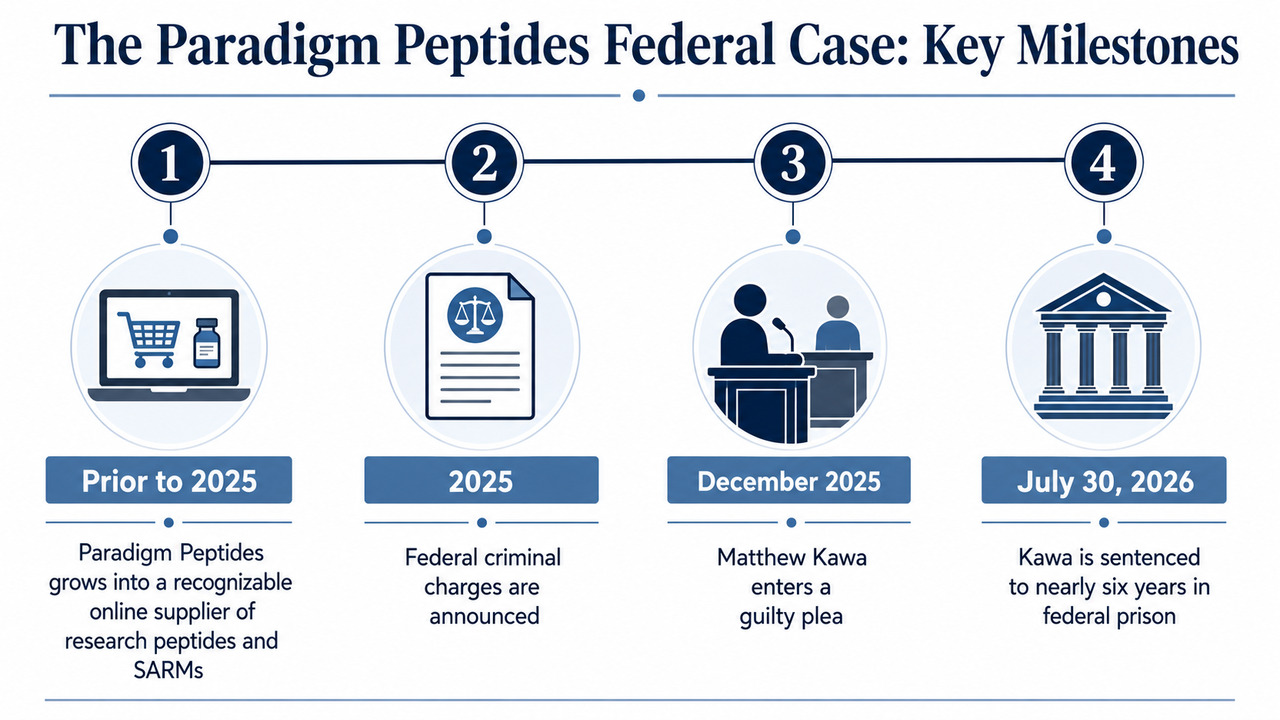
By the time Matthew Kawa was sentenced on July 30, 2026, the case had been developing for years. What many people saw as an overnight news story was actually the conclusion of a lengthy federal investigation involving multiple agencies, laboratory testing, and criminal charges.
| Date | Event |
|---|---|
| Prior to 2025 | Paradigm Peptides grows into one of the largest online suppliers of research peptides and SARMs. |
| 2025 | Federal investigators announce criminal charges against Matthew Kawa and Paradigm Peptides. |
| December 2025 | Kawa enters a guilty plea in federal court. |
| July 30, 2026 | Kawa is sentenced to nearly six years in federal prison. |
The Charges Went Beyond Selling Peptides
One of the biggest misconceptions circulating online is that this was simply a prosecution for selling peptides labeled “Research Use Only.”
That isn’t how federal prosecutors described the case.
According to the Department of Justice, investigators alleged that Paradigm Peptides operated a business that imported unapproved drugs into the United States and marketed products that were intended for human use despite carrying research-only labeling. Prosecutors also alleged the company sold products that were misbranded or adulterated, including products marketed as SARMs that laboratory testing indicated actually contained testosterone.
Whether someone agrees with current FDA policy or believes peptide regulations should change is a separate discussion. The important point for clinic owners is that this case was built around the government’s allegation that the company’s overall business practices violated federal law, not simply because an RUO label appeared on a bottle.
The Guilty Plea Matters
Another detail often omitted from social media discussions is that this case did not proceed to a jury verdict.
In December 2025, Matthew Kawa entered a guilty plea in federal court. That plea avoided a trial and moved the case into the sentencing phase, where the court considered the admitted conduct, evidence presented by prosecutors, victim impact information, and the applicable federal sentencing guidelines before imposing sentence.
The sentence was not based solely on allegations in a news release. It followed a criminal proceeding that included a guilty plea and judicial review under the federal court system.
Related reading
Enforcement on clinics that sourced non-pharmacy products is not limited to this case
There are many other examples of clinics and prescriber-facing operations facing scrutiny after sourcing products labeled RUO, PUO, or CUO instead of through licensed 503A/503B pharmacies or FDA-approved manufacturers. See Peptide Sourcing: The Legal Reality Providers Can't Afford to Ignore for a broader look at how regulators treat non-pharmacy sourcing.
Beyond the “Research Use Only” Label
If there’s one lesson clinics should take from this case, it’s that regulators rarely evaluate a single label in isolation. Instead, they look at the entire picture. That includes questions such as:
- Where did the products originate?
- How were they imported?
- How were they marketed?
- What did laboratory testing show?
- Who were the intended customers?
- How were the products actually being used?
An RUO disclaimer may describe how a manufacturer intends a product to be used, but regulators can also consider advertising, customer communications, sales practices, website content, payment records, shipping patterns, and other evidence when evaluating whether products are actually being marketed for human use. That broader approach has been reflected in FDA enforcement actions for years and is consistent with the allegations described in the Paradigm Peptides case.
The Biggest Misconceptions Already Spreading Online
As with many high-profile enforcement actions, the headlines have generated plenty of commentary, but not all of it is accurate. The following are some of the most common claims circulating online.
| Claim | Reality |
|---|---|
| “RUO products are now illegal.” | No. The case was not simply about the existence of an RUO label. Prosecutors alleged broader violations involving sourcing, marketing, and product contents. |
| “Clinics using compounded peptides are next.” | There is no indication that this case directly targets medications dispensed by licensed 503A or 503B compounding pharmacies. Those operate under a different regulatory framework. |
| “Every peptide company is at risk.” | Regulatory risk depends on each company’s business practices, sourcing, marketing, and compliance. This case should not be interpreted as applying equally to every business in the industry. |
| “This proves peptides don’t work.” | The case addressed alleged regulatory and criminal violations, not whether peptide therapies are clinically effective. |
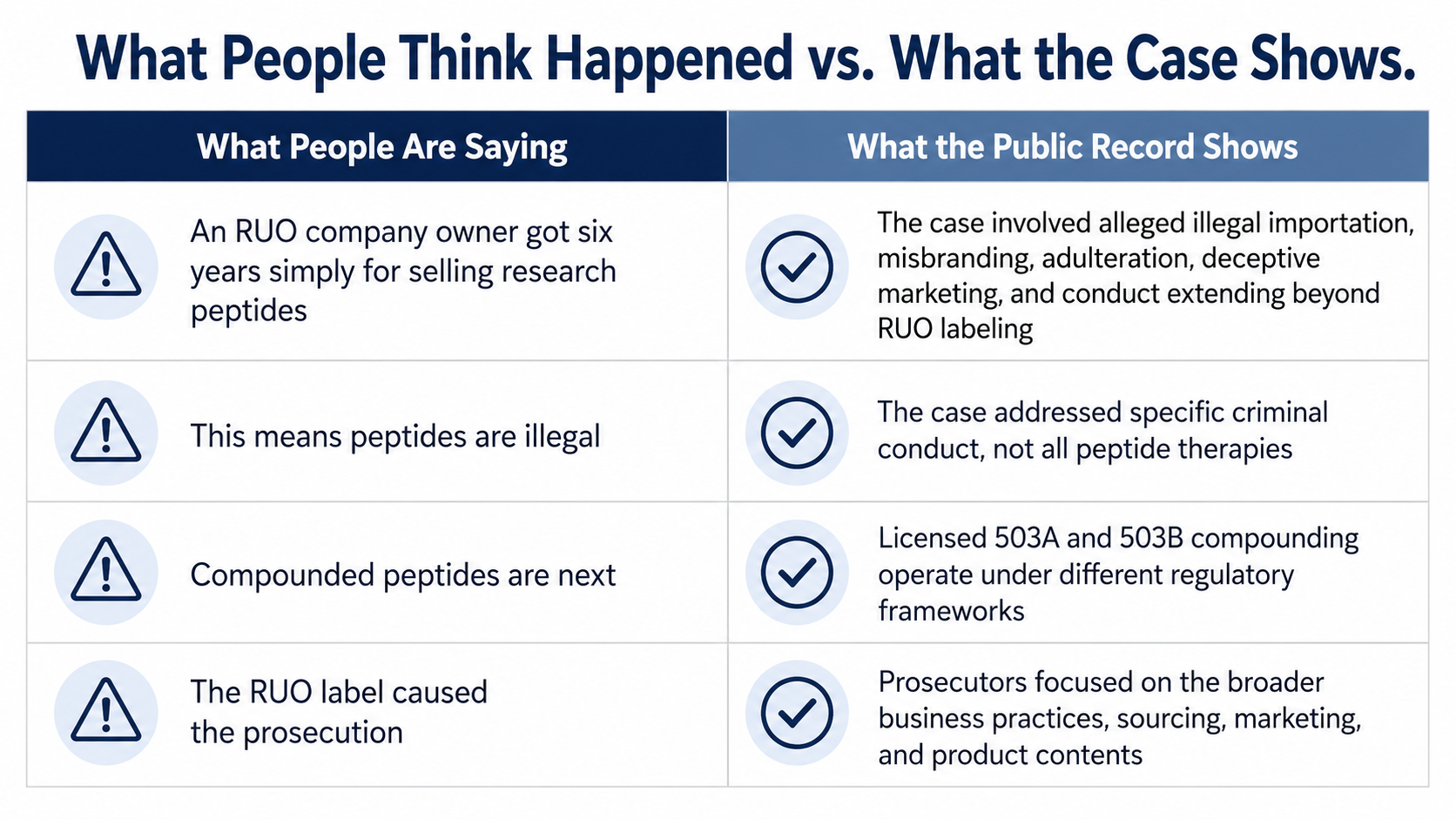
Separating these issues helps clinics make decisions based on facts rather than fear.
Why This Matters to Legitimate Clinics
Most medical practices are operating very differently from the business model described in the Paradigm Peptides case. Licensed healthcare providers typically work with licensed pharmacies, maintain medical records, obtain informed consent, and prescribe medications within established regulatory frameworks.
Even so, this case serves as a reminder that compliance extends beyond patient care. It also includes:
- Vetting suppliers.
- Understanding where products originate.
- Reviewing marketing language.
- Maintaining appropriate documentation.
- Working within applicable federal and state regulations.
For most clinics, those practices are already part of everyday operations. The Paradigm Peptides case reinforces why they matter. If you want a starting point, our supplier diligence checklist walks through how to vet a source before you buy.
What Does This Mean for Legitimate Medical Practices?
If you own or manage a medical practice, med spa, or wellness clinic, the Paradigm Peptides case should not be viewed as a signal to panic. It should be viewed as an opportunity to review your compliance practices.
One of the biggest mistakes providers can make after a high-profile enforcement action is assuming that every business using peptides faces the same level of regulatory risk. That simply isn’t true. How a product is sourced, prescribed, dispensed, marketed, and documented matters.
Understanding the Different Categories of Peptide Products
Although these products are often discussed together online, they exist under very different regulatory pathways.
| Category | Intended Purpose | Regulatory Oversight | Typical Customer |
|---|---|---|---|
| Research Use Only (RUO) | Laboratory research only. Not intended for diagnosis, treatment, or prevention of disease in humans. | FDA regulates labeling and intended use. Human marketing may create significant regulatory concerns. | Universities, laboratories, researchers |
| 503A Compounded Medications | Patient-specific medications prepared pursuant to a valid prescription. | State boards of pharmacy and FDA oversight under Section 503A. | Individual patients through licensed healthcare providers |
| 503B Outsourcing Facilities | Compounded medications produced under FDA registration and Current Good Manufacturing Practice (CGMP) requirements for office use and healthcare facilities. | FDA oversight under Section 503B. | Hospitals, surgery centers, physician practices |
| FDA-Approved Drugs | Commercially manufactured medications reviewed for safety, efficacy, and quality before approval. | Full FDA approval and post-market oversight. | Patients through licensed prescribing providers |
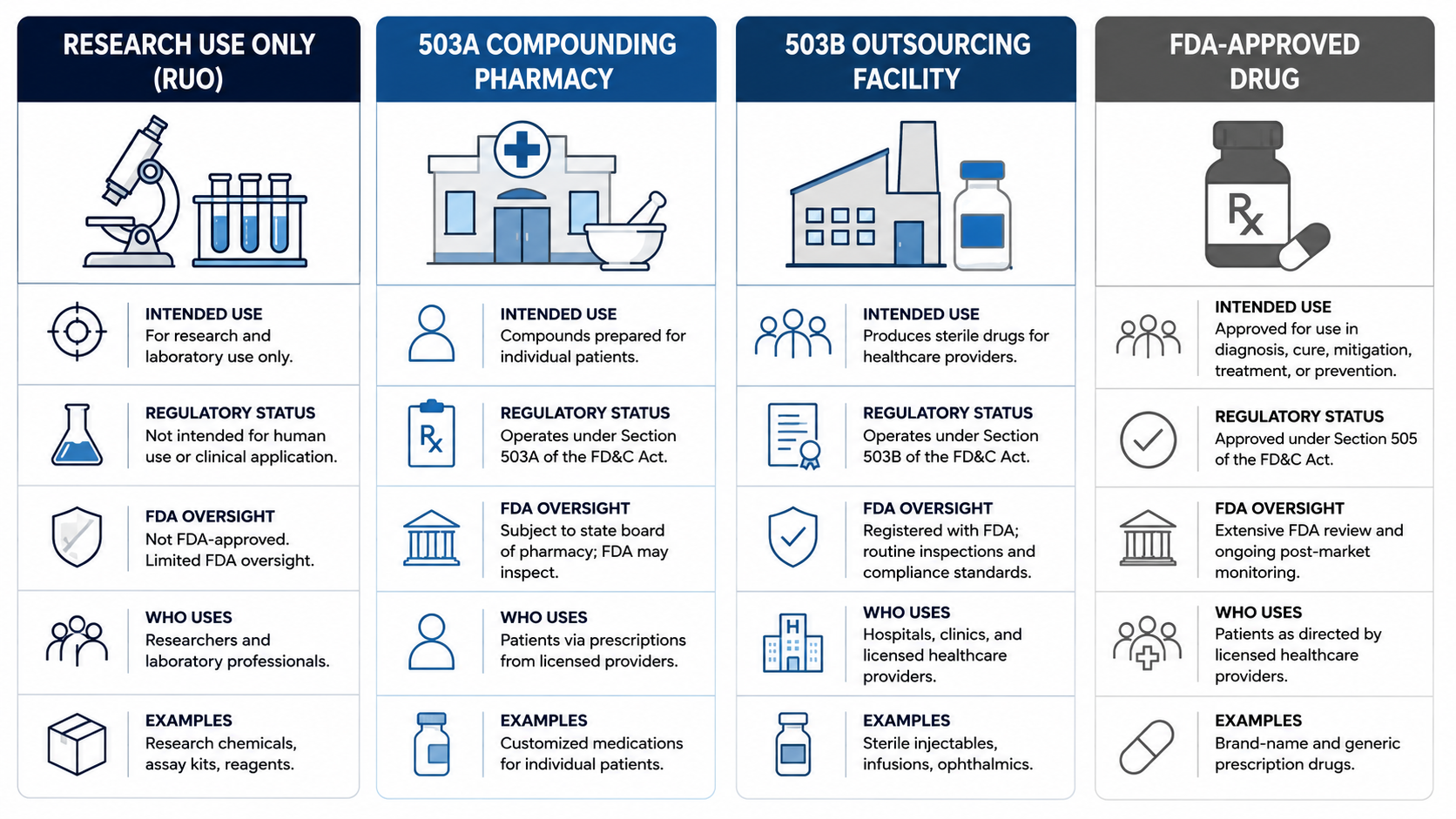
While these categories can sometimes involve similar active ingredients, they are not interchangeable from a regulatory standpoint. That distinction is one of the biggest takeaways from the Paradigm Peptides case.
Label glossary
PUO, CUO, and RUO are essentially the same thing
You may see peptides marketed as Professional Use Only (PUO), Clinical Use Only (CUO), or Research Use Only (RUO). From a compliance perspective, these labels are generally used interchangeably. None of them transform a non-pharmacy product into a pharmacy-grade product.
Non-Pharmacy means non-compliant
Anything that is not sourced from a licensed 503A/503B compounding pharmacy or an FDA-approved manufacturer is considered Non-Pharmacy. It is not considered compliant, whether it is labeled RUO, PUO, CUO, or not labeled at all.
Why This Case Doesn’t Automatically Affect Compounded Peptides
Since the sentencing was announced, one question has appeared repeatedly across provider forums and social media: “Does this mean compounded peptides are going away?”
Based on the publicly available information surrounding this case, the answer is no.
The Paradigm Peptides prosecution focused on allegations involving the importation of unapproved drugs, marketing practices, and products investigators alleged were misbranded or adulterated. It was not a criminal prosecution of licensed compounding pharmacies operating under Sections 503A or 503B of the Federal Food, Drug, and Cosmetic Act.
That does not mean compounded medications are free from FDA oversight. Compounding pharmacies continue to operate under their own regulatory requirements, and providers should stay informed about evolving FDA guidance, state pharmacy regulations, and applicable prescribing standards. Those are separate conversations from the criminal conduct alleged in this case.
What About GLP-1 Clinics?
Many ClinicHuddle readers either prescribe GLP-1 medications today or are considering adding medically supervised weight-loss services. The Paradigm Peptides case does not directly change the legal framework governing FDA-approved GLP-1 medications or compounded GLP-1 products dispensed through licensed pharmacies. However, it reinforces several principles that every weight-loss clinic should already be following:
- Working with reputable pharmacy partners.
- Understanding where medications originate.
- Maintaining appropriate prescribing documentation.
- Avoiding misleading marketing claims.
- Staying current with FDA guidance and state regulations.
Those practices reduce regulatory risk regardless of which medications a clinic offers.
Five Practical Compliance Lessons for Clinics
The biggest value in studying enforcement actions isn’t learning what another business did wrong. It’s identifying opportunities to strengthen your own processes.
1. Know Your Supply Chain
Every clinic should understand exactly where its medications originate. That means knowing:
- Which pharmacy is preparing the medication.
- Whether the pharmacy is appropriately licensed.
- How products are shipped.
- What documentation is available if questions arise.
A certificate of analysis (COA) can be one useful piece of documentation, but it should never replace proper due diligence when selecting suppliers.
Related resource
Looking for compliant sourcing models?
ClinicHuddle breaks down the six most common ways to source peptides legally, from telehealth platforms to pharmacy-direct ordering. Read 6 Best Ways To Source Peptides Legally to compare the models and choose the right fit for your practice.
2. Review Your Marketing
Marketing often receives less attention than clinical operations, yet it is frequently reviewed during regulatory investigations. Take time to evaluate:
- Website language.
- Social media posts.
- Patient handouts.
- Advertising claims.
- Testimonials.
- Before-and-after photos.
Marketing should accurately reflect the services your clinic provides without overstating benefits or making unsupported claims.
3. Document Your Clinical Decisions
Good documentation protects both patients and providers. Maintain clear records showing:
- Medical history.
- Clinical rationale.
- Informed consent.
- Treatment plans.
- Follow-up evaluations.
- Prescription records.
Strong documentation demonstrates that care is individualized rather than transactional.
4. Work With Qualified Partners
Whether you’re selecting a pharmacy, laboratory, telehealth platform, or technology vendor, perform the same level of due diligence you would expect from someone evaluating your own clinic. Ask questions. Request documentation. Understand their quality systems. The lowest price is rarely the most important consideration.
5. Stay Informed
Healthcare regulations continue to evolve. The peptide industry has changed dramatically over the past several years, and additional regulatory developments are likely. Clinics that stay informed and adapt proactively are generally better positioned than those reacting after enforcement actions make national headlines.
Compliance Self-Assessment
The following questions can serve as a simple internal review for your practice.
| Question | Why It Matters |
|---|---|
| Do you know exactly where every medication you prescribe originates? | Supply-chain transparency is a foundational compliance principle. |
| Are you working with appropriately licensed pharmacy partners? | Licensing and oversight help reduce regulatory risk. |
| Would your website accurately describe your services if reviewed by a regulator? | Marketing claims often receive significant scrutiny. |
| Is every prescription supported by appropriate clinical documentation? | Documentation demonstrates individualized patient care. |
| Have you reviewed your compliance procedures within the past year? | Regular reviews help identify issues before they become problems. |
None of these questions guarantee compliance on their own. Together, however, they represent good operational practices that help clinics build a stronger compliance culture.
Looking Ahead
The Paradigm Peptides sentencing will likely remain a reference point in discussions about peptide regulation for years to come. But it should not become a source of unnecessary fear.
Instead, it should encourage providers to ask thoughtful questions about sourcing, documentation, marketing, and patient care. For clinics already following established medical and regulatory standards, those conversations reinforce practices that should already be part of daily operations.
Frequently Asked Questions
Does the Paradigm Peptides sentencing make all peptides illegal?
No.
The Paradigm Peptides case involved specific criminal allegations described by the U.S. Department of Justice, including importing unapproved drugs, deceptive marketing practices, and distributing products prosecutors alleged were misbranded or adulterated. The sentencing should not be interpreted as a blanket prohibition on peptide therapies or products.
Providers should evaluate the facts of this case separately from the broader regulatory framework governing FDA-approved medications and compounded drugs.
Does this affect clinics using compounded peptides?
Not directly.
Licensed 503A compounding pharmacies and 503B outsourcing facilities operate under different sections of the Federal Food, Drug, and Cosmetic Act than the activities described in the Paradigm Peptides prosecution.
That does not mean compounded medications are free from FDA oversight. It simply means this case was not a criminal prosecution of legitimate pharmacy compounding.
What does "Research Use Only" actually mean?
Research Use Only (RUO) products are intended for laboratory research and are not marketed for diagnosing, treating, curing, or preventing disease in humans. Labels such as Professional Use Only (PUO) or Clinical Use Only (CUO) are commonly used interchangeably with RUO in this space. Regulators may evaluate much more than a product label. Marketing, sourcing, intended use, customer communications, product contents, and distribution practices may all become relevant when determining whether a business complies with applicable federal law.
Should clinics stop offering peptide therapies?
This case does not, by itself, suggest that clinics should discontinue appropriately prescribed peptide therapies obtained through legitimate channels. Instead, it serves as a reminder to periodically review supplier qualifications, documentation, prescribing practices, and marketing materials to ensure they remain consistent with current regulatory expectations.
What is the biggest takeaway from this case?
The Paradigm Peptides sentencing demonstrates that regulators evaluate an entire business model rather than focusing on a single disclaimer or label. For legitimate clinics, that means continuing to prioritize:
- Responsible sourcing
- Appropriate prescribing
- Thorough documentation
- Accurate marketing
- Ongoing compliance reviews
Recommended References
The following resources provide additional context and authoritative information related to this topic.
| Resource | Why It's Helpful |
|---|---|
| U.S. Department of Justice — United States v. Matthew Kawa | The primary government source describing the investigation, guilty plea, sentencing, and allegations. |
| United States v. Matthew Kawa et al. (case information) | Federal case information and procedural history. |
| CBS News — Judge sentences peptide vendor to nearly six years in prison | National reporting summarizing the sentencing and broader industry reaction. |
Final Thoughts
The Paradigm Peptides sentencing will likely remain one of the most significant regulatory events the peptide industry has seen in recent years. Unfortunately, many of the early discussions surrounding the case have reduced it to a simple headline.
The publicly available court records tell a more nuanced story. According to the Department of Justice, the case involved allegations concerning product sourcing, importation, labeling, marketing practices, and product integrity that extended well beyond the presence of a “Research Use Only” label.
For clinics, the practical lesson isn’t that peptide medicine is ending. Nor is it that every company operating in the peptide space faces the same regulatory risk. The lesson is that compliance should be reflected throughout the entire organization — supplier selection, clinical documentation, marketing, and everyday operations.